
Congratulations on the birth of your baby! The first few weeks with a newborn are magical, intense, and often marked by a steep learning curve. If you've decided to breastfeed your baby, you've probably imagined intimate, peaceful moments. But for many mothers, the reality is quite different at first: every suckling feels like tiny razor blades pulling at the breast. Tears flow, toes curl, and the fear of the next feeding grows.
If this sounds familiar, let me tell you one thing first: You are not alone! Pain during breastfeeding at the beginning of the breastfeeding relationship are a common phenomenon that, unfortunately, is still rarely spoken about openly. Mothers are often told they just need to „power through“ until their nipples have toughened up. But that is a dangerous myth. Breastfeeding doesn't have to and shouldn't hurt!
We therefore say very clearly: No More Pain! 5 Causes of Sore Nipples & How to Get Rid of Them Forever. In this comprehensive guide, we'll get to the bottom of pain, uncover its true triggers, and provide you with evidence-based, tried-and-tested solutions so you can finally enjoy your breastfeeding journey to the fullest.
Why do my nipples hurt when breastfeeding?
In the first days and weeks, many mothers desperately ask themselves the question: Why do my nipples hurt when breastfeeding? Is this normal?
To answer this question, we need to distinguish between normal sensitivity and actual pain. In the first few days after giving birth, it’s completely normal for you to sensitive nipples When your baby latches on, you might feel a strong tug or a slight pinch for the first 10 to 30 seconds. This initial latch pain is caused by the strong suction and the unusual stretching of the tissue. However, this feeling should subside once your milk starts to flow and your baby is drinking at a steady rhythm.
However, if the pain persists throughout the entire feeding, the nipple appears misshapen after feeding (e.g., looks like a flattened lipstick), bleeds, cracks, or throbs, then we are talking about Nipple pain, which are a clear warning sign from the body. Sore, cracked, or bleeding nipples are never a necessary evil, but always a symptom that something needs to be optimized.
Let's now take the five most common Sore nipples causes shining a light on it and finding out how to tackle the problem at its root.
Cause 1: Incorrect application and positioning (The most common reason)
In over 80% of cases, sore and injured nipples are caused by poor latching technique. If your baby isn’t taking the nipple deep enough into their mouth, it constantly rubs against the baby’s hard palate while they suck. This quickly leads to severe abrasions, cracks (rhagades), and unbearable pain.
The right breastfeeding latch
A Correct breastfeeding latch This is the absolute foundation for a pain-free breastfeeding relationship. Here is a step-by-step guide on how to best latch your baby:
- Find a comfortable position: Make sure you are sitting or lying down comfortably. Your back, arms, and shoulders should be supported. Use nursing pillows, but don't just place the baby on the pillow; bring the baby to your breast – never bring your breast to the baby.
- Belly to belly Your baby should be completely turned towards you. The baby's ear, shoulder, and hip should form a straight line. They shouldn't have to turn their head to reach the breast (try drinking a large gulp of water with your head turned to the side yourself!).
- Nose to nipple Position your baby so their nose is level with your nipple. This stimulates the rooting reflex. The baby will tilt their head back slightly, open their mouth wide, and „latch“ onto the nipple.
- Asymmetrical Application The baby should not aim for the center of the nipple. Their chin should touch the breast first, sinking deep into the breast tissue, and then opening the mouth wide over the nipple and a large portion of the areola. The nipple then lands deep in the soft palate where it is protected from friction.
- Control Your baby's lips should be flanged outward (like a fish). You should not hear smacking noises, only a deep, rhythmic gulping.
Properly removing the baby from the breast
Just as important as investing is correct baby detachment from the breast. If you simply pull your baby off the breast while they are still sucking, the negative pressure will tug at the sensitive skin – that's a direct path to cracks and injuries.
The pinky finger trick: Gently slide your clean little finger into the corner of your baby’s mouth until you feel the vacuum break. Only then should you take your baby off the breast. This is an essential step to Prevention of cracked nipples.
Cause 2: Mechanical irritation and incorrect accessories
Even if the application technique is perfect, external mechanical stimuli can severely irritate the sensitive skin.
Too small or too tight nursing bras: A bra that permanently flattens the nipple or chafes it with rough seams interferes with blood circulation and irritates the skin surface. Pay attention to soft, seamless fabrics and sufficient space.
Incorrect pump adapters: When you pump in addition, the size of the breast flange (the funnel you place on your breast) is crucial. If the flange is too small, your nipple will rub against the plastic wall with every pull. If it's too big, too much of your areola will be drawn into the flange, leading to swelling and cracks. It's best to get advice from a specialist retailer or a lactation consultant to measure your individual size.
Rough towels and breast pads: Avoid rubbing your breasts dry after showering. Gently pat them dry instead. Also, change disposable nursing pads regularly, as moist milk residue combined with cellulose creates a rough, skin-irritating environment.
Cause 3: Infections - Thrush and Bacteria
Sometimes sore nipples simply don't heal, even if the latch has been corrected. In such cases, an infection is often the cause. The most common form is so-called thrush, an infection with the yeast fungus. Candida albicans.
A fungus loves warm, moist, and sweet conditions – so a breastfeeding mother's breast is the perfect paradise for it. Thrush often manifests as a sudden, stabbing, burning pain that occurs during, and particularly after radiates deeply into the chest. The nipples can be very red, itchy, shiny, or scaly.
How do I recognize breast thrush in a baby?
Since mother and child form a unit when breastfeeding, they almost always infect each other with thrush (ping-pong effect). Therefore, it is extremely important to know: How do I recognize breast thrush in a baby?
Watch for the following symptoms in your child:
- White, wipeable patches in the mouth: A white film on the tongue, palate, or inner cheeks that cannot be easily wiped away (unlike milk residue) or bleeds red underneath.
- Restlessness during breastfeeding: The baby latches on, cries out, and releases the breast again because sucking hurts the inflamed mouth.
- Persistent diaper rash: A swollen bottom that is severely red, has pustules, and doesn't respond to conventional diaper creams is often a sign that a yeast infection has spread throughout the baby's digestive tract.
Important: A yeast infection must always be treated medically! See your gynecologist and pediatrician. Mother and child must always simultaneously may be treated with antifungal gels or ointments (e.g., miconazole or nystatin), even if only one of them shows symptoms. Also, boil pacifiers, bottle nipples, and breast pump accessories for 10 minutes daily and wash burp cloths and nursing bras at at least 60 degrees Celsius.

Cause 4: Anatomical peculiarities in the baby (e.g., short frenulum)
If all obvious sources of error have been ruled out and breastfeeding continues to be agonizing, it's worth taking a look inside the baby's mouth.
An excessively short lingual frenulum (ankyloglossia) or labial frenulum can severely restrict tongue and lip movement. For effective, pain-free sucking, the baby must be able to extend their tongue far over the lower gum line to pad the nipple from below and milk the breast with wave-like motions.
If the frenulum is too short, the tongue slips back during sucking. The baby then tries to compensate for the lack of grip by clenching their jaws tightly (sucking reflex) or by creating immense suction with their lips (intensified sucking). The result: the nipple is squeezed, rubbed, and becomes sore.
If you suspect your baby has anatomical limitations, consult a trained professional (more on this under „Seeking Expert Help“) who can perform an assessment and advise you on a possible frenotomy.
Cause 5: Vasospasm (blood vessel spasms)
An often overlooked cause of extreme pain is vasospasm (also called Raynaud's syndrome of the nipple).
Nipple vasospasm symptoms and treatment
In vasospasm, the small blood vessels in the nipple constrict. This usually happens immediately after breastfeeding, when the warm nipple is exposed to cooler room air.
Nipple Vasospasm: Symptoms and Treatment The symptoms are very characteristic. When the baby detaches from the breast, the nipple suddenly turns snow-white (due to lack of blood flow). Sometimes the color subsequently changes to blue or purple before returning to pink. This color change is accompanied by a very strong, burning, stabbing, or throbbing pain that can last from minutes to hours.
What can you do about it?
- Heat is your best friend: Immediately cover the nipple with your warm palm or a warmed cherry stone pillow after unlatching.
- Avoid drafts Make sure you don't get cold while breastfeeding.
- Magnesium and Calcium: High doses of magnesium (and sometimes calcium and vitamin B6) relax the muscles of the blood vessels. Discuss the exact dosage with your doctor or midwife.
- Wounds heal Vasospasms often occur secondarily as a reaction to an already injured nipple. Once the wounds heal, the vascular spasms usually disappear as well.
First Aid and Care: Proper Nipple Care During Breastfeeding
Once the damage is done, a consistent, healing-promoting routine is required. The topic Proper Nipple Care During Breastfeeding is crucial to break the pain cycle. There are fantastic tools on the market today that accelerate wound healing.
Home remedies for sore nipples
Often, the simplest natural methods are enough to help:
- Breast milk The best and cheapest home remedy is one you already have. Breast milk contains antibodies, is anti-inflammatory, and nourishes the skin. Simply rub a drop of breast milk onto your nipple after breastfeeding and let it air dry.
- The tea bag trick: Black tea contains tannins, which have an astringent effect and soothe the skin. Pour boiling water over a bag of unflavored black tea, let it steep briefly, gently squeeze it out, and let it cool. Then place it on the sore nipple for 10 to 15 minutes. (Caution: Gently wash the nipple before the next feeding, as babies dislike the bitter taste).
- Coconut Oil: High-quality, cold-pressed organic coconut oil naturally has antibacterial and antifungal properties and keeps the skin supple.
This Home remedies for sore nipples are wonderful for mild irritations, but deeper wounds require more intensive care products.
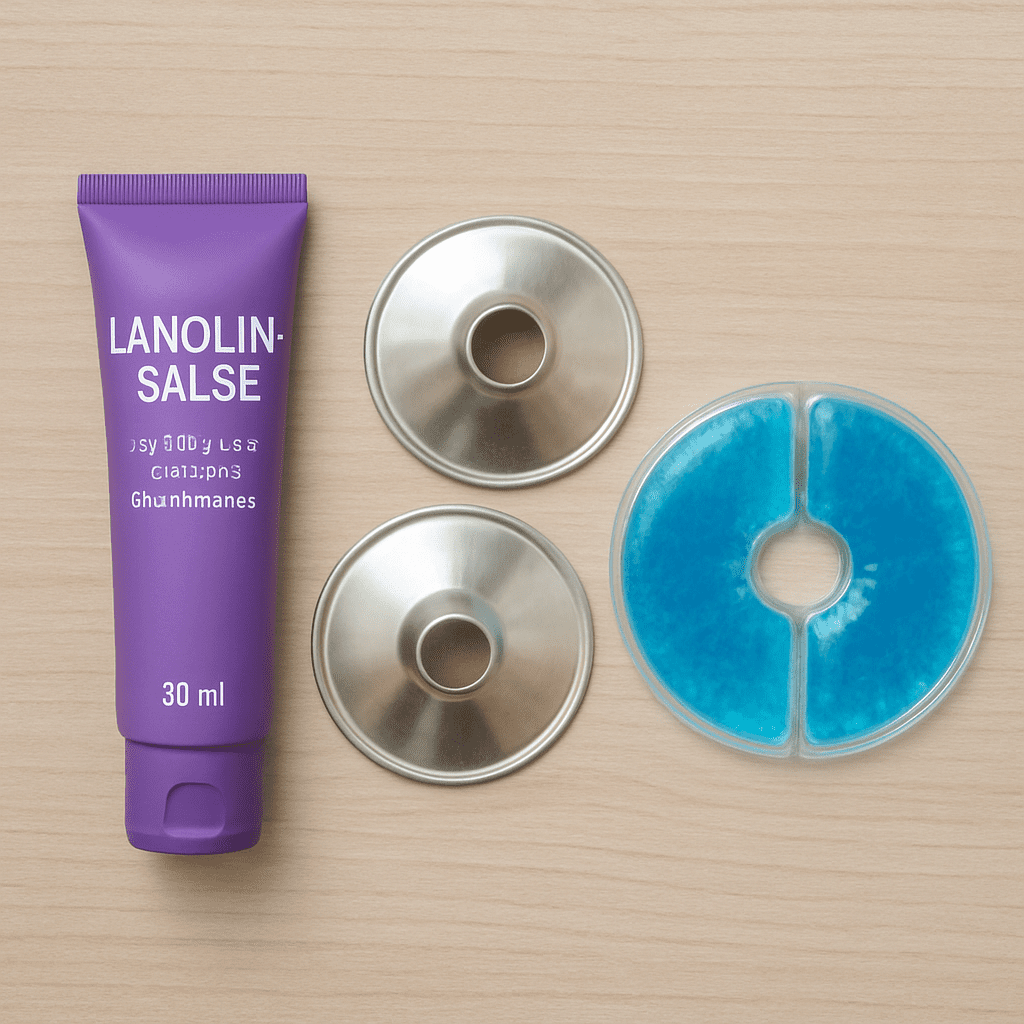
Lanolin Ointment vs. Silverette Cups
Two of the most popular helpers in times of need are lanolin and silver nipple shields. Many mothers wonder: Lanolin Ointment vs. Silverette Cups – What's better? The answer depends on the nature of your complaints.
Lanolin Ointment (highly purified wool fat): Lanolin forms a protective layer on the skin and supports the principle of moist wound healing. Wounds heal faster in a moist environment and do not form a hard scab that would painfully reopen during the next feeding.
- Advantages: Does not need to be washed off before breastfeeding, as it is completely safe for the baby. Provides deep moisture.
- Disadvantages: Can sometimes stick too strongly to clothing with very deep cracks, if no nursing pad is used.
Silverettes These are small caps made of 925 or.
- Advantages: Silver has a natural antibacterial, antiviral, and antifungal effect. They provide pleasant cooling and act like a physical shield, preventing any friction from clothing. A drop of breast milk under the nipple shield also promotes moist wound healing.
- Disadvantages: The purchase costs are higher. If they don't fit properly, the edges can press into the breast tissue.
Tip from practice: Some mothers combine both by applying a thin layer of lanolin and then placing the silver nursing cup over it as a protective shield.
Multi-Mam Compresses vs. Hydrogel Pads
Another showdown of skincare products: Multi-Mam Compresses vs. Hydrogel Pads. Both aim to intensely cool and care, but they work with different active ingredients.
Multi-Mam Compresses: These soft fleece compresses are soaked in a patented 2QR complex (a bioactive gel based on Aloe Barbadensis).
- They naturally neutralize harmful bacteria and block their colonization in the wound.
- They massively promote the healing process and cool wonderfully.
- The gel is safe and does not need to be washed off before breastfeeding.
Hydrogel pads (e.g., from Medela, Ardo, or Lansinoh): These pads are made of special polymers that store water.
- They offer an extremely strong, long-lasting cooling effect (especially effective when stored in the refrigerator).
- You keep the wound moist and pad the nipple.
- Attention: Hydrogel pads should be used with caution in the presence of signs of bacterial infection or heavily exuding wounds, as the highly occlusive (air-sealing) environment could promote bacterial growth. Multi-Mam compresses are often a better choice here.
Preventing complications when nipple soreness worsens
Sore nipples are not only painful, they are also an entry point for bacteria. If you tense up from pain or breastfeed your baby less often or for shorter periods due to the pain, your breast may not be emptied sufficiently. This leads us to subsequent problems.
Help with blocked milk ducts and sore breasts
A milk duct blockage occurs when milk ducts are blocked and milk can no longer drain properly. The breast feels heavy, hard, extremely tender lumps form, and the skin over them may be slightly reddened.
Help with blocked milk ducts and sore breasts looks like this:
- Warm before breastfeeding: Apply warm, moist compresses or a heating pad to your chest to widen the milk ducts.
- Gently massage the breast: Gently massage the firm spot towards the nipple (no painful kneading!).
- Positioning the baby correctly Position the baby so that its chin is pointing towards the hardening. That's where the suction is strongest.
- Cool after breastfeeding: Use quark compresses (cold, decongestant, anti-inflammatory) or special cooling pads to slow down milk production in this area somewhat and soothe the tissue.
Signs of breast inflammation
If a milk duct blockage is not resolved in time or bacteria enter the breast tissue through open cracks in the nipple, mastitis (breast inflammation) can develop. It is vital for your health to Signs of breast inflammation to be able to
- Sudden, high fever (often over 101.3 °F)
- Chills and a strong feeling of being sick (like you have a bad flu)
- A clearly reddened, overheated, swollen, and very painful area on the breast (often wedge-shaped)
- Red welts stretching across the chest
Recommendation for action: With these symptoms, you must see a doctor immediately! Bacterial mastitis often needs to be treated with antibiotics that are safe for breastfeeding. Rest is your most important medicine right now. Get to bed with you and your baby!
Benefits of healing wool for mastitis
A traditional remedy often recommended by midwives for sore breasts and early inflammation is medicinal wool. The Benefits of healing wool for mastitis lie in their nature: It is natural, unspun sheep wool that is extremely rich in natural lanolin (wool fat).
- It is highly breathable, which prevents moisture buildup.
- The contained lanolin continuously conditions the skin.
- It gently warms, which stimulates blood circulation and milk flow during a milk stasis.
- Important exception: Please lay healing wool not on deep open, bleeding cracks or when a fungal infection (thrush) is suspected, as tiny wool fibers can get caught in the wound.
The Path to Pain-Free Breastfeeding: Seeking Expert Help
You've checked your application technique, tried all the ointments, and the pain still remains? Then it's high time for professional help.
Unfortunately, the knowledge of many pediatricians, gynecologists, and even some nurses on the postpartum ward is often not deep enough when it comes to breastfeeding complications. Their training usually covers this specialized topic only superficially. If you reach a point where you want to stop breastfeeding just to escape the pain, you need specialists.
Consultation with an IBCLC Lactation Consultant
The absolute gold standard certification in lactation is the IBCLC (International Board Certified Lactation Consultant) credential. Consultation with an IBCLC Lactation Consultant can save your breastfeeding journey.
What makes an IBCLC consultant different?
- She usually takes 60 to 90 minutes for a detailed medical history.
- She observes a complete feeding session and assesses not only your breasts but also your baby's oral management (tongue function, jaw movements).
- She can identify anatomical issues like a posterior (hidden) tongue-tie, which is often overlooked by others.
- She creates a personalized, step-by-step treatment plan to promote wound healing and ensure milk production.
You can usually find a list of certified lactation consultants in your area on the websites of professional organizations (e.g., BDL in Germany). Invest in this help – it's worth every cent if it enables you to have a happy, months-long, pain-free breastfeeding relationship.
Conclusion: Don't give up, but don't suffer in silence!
As a new mother, you are currently going through peak performance – physically and emotionally. The mission No More Pain! 5 Causes of Sore Nipples & How to Get Rid of Them Forever is not an unattainable dream, but is absolutely achievable through targeted action.
Always remember:
- Analyze the investment: 80% of these problems can be solved by applying an asymmetrical, deep application.
- Pay attention to hygiene and materials: Avoid friction and check your pump size.
- Detect infections Treat thrush in you and your baby promptly.
- Check the anatomy: Have the tongue and lip tie checked by professionals.
- Watch your vessels: Keep nipples warm to prevent vasospasm.
Care for your strained breasts with love – whether with lanolin, silver cups, or hydrogel pads – and don't hesitate to bring in an IBCLC lactation consultant early on.
Breastfeeding is a wonderful journey that offers you and your baby a deep bond and the best possible health benefits. The beginning may be rocky, but once the wounds have healed and things have settled down, you will be rewarded with intimate, pain-free cuddle moments. You can do this!